Start with the workday you actually have
Before planning combinations, think about what your clothes need to do. A day spent mostly at a desk may call for different shoes and layers than one involving a long commute, meetings or time outdoors. Your workplace dress code matters too: the same jeans and knitwear that suit one office may not fit another. Use the expectations of your own workplace as a guide rather than building outfits around an imaginary ideal.
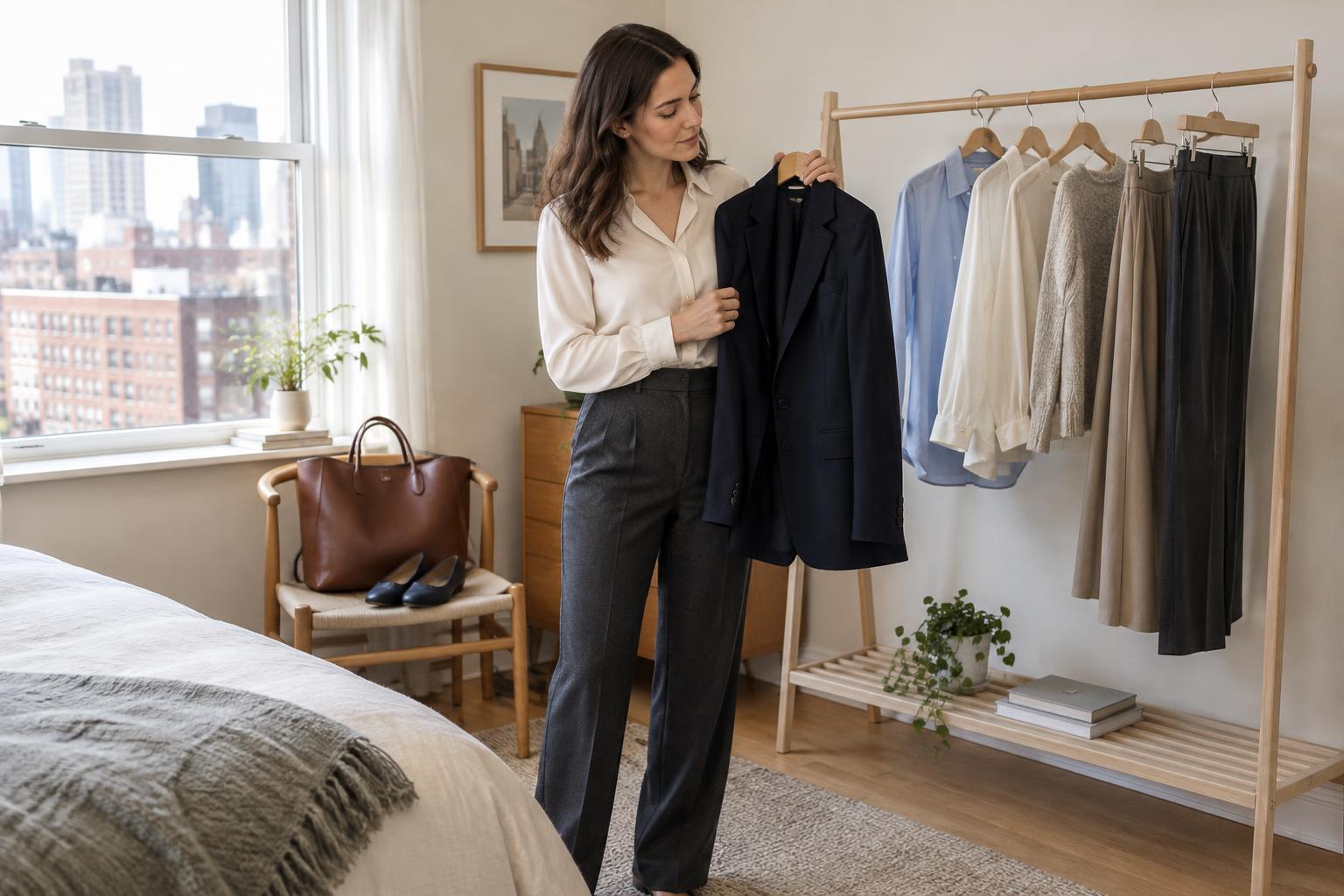
Choose a small group of pieces you already wear comfortably. For example, you might start with two pairs of trousers, a skirt or dress, two tops, a shirt, a knit layer and a jacket. They do not all have to match, but several should work together. If a shirt only feels right with one pair of trousers, it can still earn its place; it simply offers fewer combinations than a top that works with both trousers and your skirt.
Build combinations around a few reliable links
The easiest way to rewear work clothes is to identify pieces that connect different outfits. A jacket that fits over both a fine knit and a shirt is one link. Trousers that work with flats and boots are another. These links let you change one part of an outfit without having to rethink everything else. Try laying out a few complete looks, including shoes and an outer layer, to see which combinations genuinely work.
Colour can make this simpler without requiring a wardrobe of neutrals. Pick two or three colours you enjoy wearing together, then use a quieter shade or a familiar texture to connect them. A patterned blouse, for instance, might work with dark trousers one day and a plain skirt another. The goal is not to make every item interchangeable. It is to have enough overlap that getting dressed does not depend on finding one specific piece clean and ready.
Change the shape, not just the colour
Two outfits can use many of the same clothes and still feel different when their proportions change. Wear a shirt tucked into wider trousers for a defined waist, then wear that shirt open over a close-fitting top with straight trousers on another day, if your dress code allows it. A fine knit can sit neatly under a jacket or be worn on its own with a skirt. Small changes like these are often more useful than buying another version of the same top.
Pay attention to how an outfit moves and feels. A long jacket over a long skirt may look appealing on a hanger but feel cumbersome on a crowded commute. A belt might give a dress a different shape, yet be uncomfortable during a full day at a desk. Test combinations at home by sitting, walking and reaching for your bag. If you spend the day adjusting an outfit, it is probably not a practical addition to your rotation.
Use accessories to shift the emphasis
Shoes, bags and smaller accessories can help familiar clothes suit different kinds of workdays. The same trousers and top might feel more structured with a jacket and simple leather shoes, or more relaxed with a cardigan and clean trainers where those are appropriate. A scarf can bring colour near your face; a belt can make a loose shirt and trousers look more deliberate. One visible change is often enough.
Choose accessories for function as well as appearance. If you walk between stations or buildings, shoes you can comfortably wear for that journey may matter more than a dramatic outfit change. If you carry a laptop, check that your bag works with the layers you wear and does not pull them out of shape. Keeping a few dependable accessories near your work clothes makes it easier to complete an outfit without a last-minute search.
Make repeating outfits easy to maintain
A flexible wardrobe only works when its pieces are available. Check care labels before relying on an item several times a week, and leave enough room in your plan for washing, drying or airing clothes as appropriate. A spare top that works with both your usual bottoms can be especially helpful when laundry plans change. It is also worth noticing which pieces need ironing or special care: they may be less convenient for your busiest mornings.
You do not need a rigid outfit calendar. Try noting three or four combinations that feel good and suit different workday demands, then keep them in mind or save a simple list on your phone. When one combination feels stale, change a layer, shoe or silhouette before deciding you need something new. Repeating pieces is not a limitation; it gives you the chance to learn which clothes consistently make daily dressing easier.


