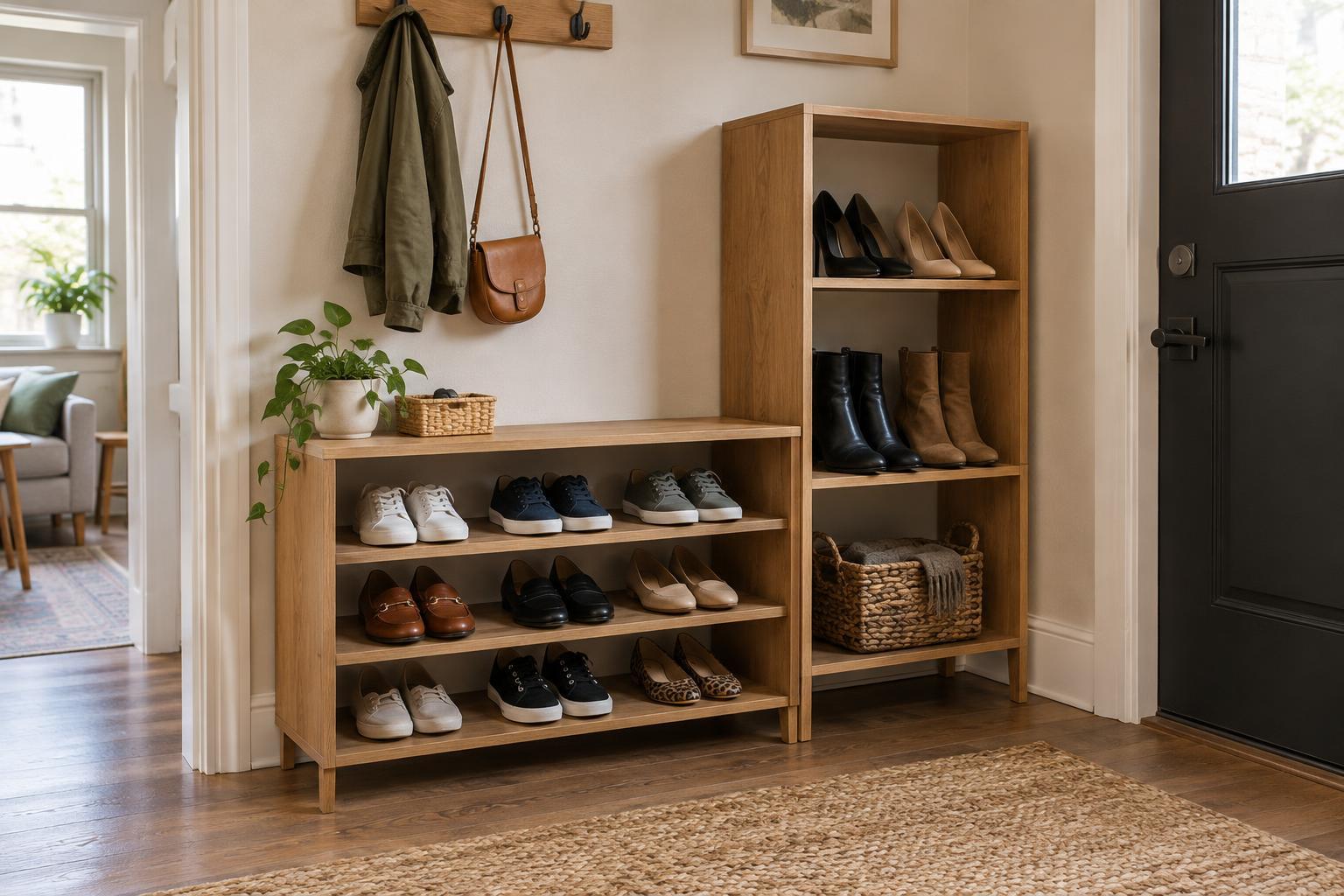
Start with the shoes you reach for most
A shoe collection is easier to organise when storage follows your routine rather than a single rule about where shoes belong. Take every pair out of its usual spot and group them by use: everyday walking shoes, work shoes, weekend options, weather-specific footwear and pairs for occasional events. This gives you a clearer view of how much space each group needs. It is also a chance to set aside pairs that need cleaning or repair and reconsider those you no longer wear.
Give the easiest-to-reach space to shoes you use most often. A low shelf or open rack near the door can work for daily pairs, provided it does not block a walkway. If you change shoes after a commute, you may prefer to keep workday pairs closer to your wardrobe. The aim is to avoid searching through rarely worn shoes each morning just to find the pair you need.
Choose storage that shows you what you own
Open shelves make pairs easy to spot and return to their place. Before buying a rack, measure both the available floor space and the height of your tallest shoes. Leave enough room to lift a pair out without disturbing the shelf above it. If floor space is limited, a narrow shelf or an over-door organiser may use space that would otherwise sit empty. Check that the organiser fits the door and allows it to close comfortably.
Boxes can be useful for shoes you wear less often, but opaque boxes make it easy to forget what is inside. Clear boxes or simple labels solve that problem. Put a pair together in each box, with the label facing outward, and avoid stacking so high that reaching a bottom box becomes a chore. A photograph on a box can help distinguish similar pairs, but a few descriptive words often do the job just as well.
Make the most of a small entryway or closet
In a compact home, think in zones rather than trying to fit every shoe beside the front door. Keep a small rotation of current favourites there and store the rest in a closet or under a bed. A shallow tray gives recently worn shoes a defined place to dry before they go back on a shelf. If wet footwear regularly comes through the door, choose a tray or mat that is easy to wipe clean and keep it away from items that could be damaged by moisture.
Inside a wardrobe, adjustable shelves let you change the layout as your needs change. Low shoes may fit on closely spaced shelves, while boots need more height. Under-bed containers can hold occasional or out-of-season pairs if there is enough clearance to pull them out easily. Choose containers you can open without moving heavy furniture; storage is only useful if you can reach its contents.
Store different shoes with their shape in mind
Shoes should be clean and dry before they go into a closed box or container. Give damp pairs time to air out, and avoid sealing shoes in plastic while they still feel moist. For pairs that benefit from airflow, a shelf or breathable bag may be a better choice than an airtight container. Keeping shoes away from direct heat and prolonged strong sunlight can also help protect materials and colour.
Tall boots are easier to find and less likely to flop over when stored upright, with suitable boot supports or loosely rolled paper inside the shafts. Delicate occasion shoes can go in individual boxes or bags so they do not rub against heavier pairs. Keep paired shoes together: fastening straps loosely or placing both shoes in one container makes it easier to grab the right pair when you are getting ready.
Keep the system easy to maintain
A good setup should take only a moment to use. Leave a little spare space on frequently used shelves so pairs can be put away without careful arranging. When a shoe rack is packed tightly, shoes tend to migrate back to the floor. If several pairs are competing for the same convenient spot, rotate them according to the weather and the outfits you currently wear.
Every so often, check whether the layout still matches your routine. Move frequently worn shoes forward, return occasional pairs to their labelled spots, and clear away any empty boxes that are taking up useful space. Visibility and easy access matter more than a perfectly matched set of containers: the best shoe-storage system is one you can keep using on an ordinary busy day.


