Start with what you actually keep in each drawer
A drawer can look tidy from above while hiding half its contents underneath. Before buying organisers or learning a new fold, take everything out of one drawer and group similar pieces together. Separate socks, underwear, T-shirts, workout clothes and other categories in a way that reflects how you get dressed. Working one drawer at a time keeps the task manageable if you do not have space to empty a whole dresser.
Use this moment to check what belongs there. Move pieces that need washing or repair, and set aside clothes you no longer wear for a separate decision. You do not need to make those decisions immediately. The first goal is to see how much clothing the drawer needs to hold, not to create a perfectly minimal wardrobe.
Give each drawer a clear job
Assign drawers according to both frequency of use and ease of access. Everyday underwear, socks and tops usually deserve the most convenient spaces. Less-used items, such as seasonal accessories or clothes reserved for particular occasions, can go in a lower or harder-to-reach drawer. If you choose outfits for work on weekday mornings, keeping workday basics together may be more helpful than sorting every garment strictly by type.
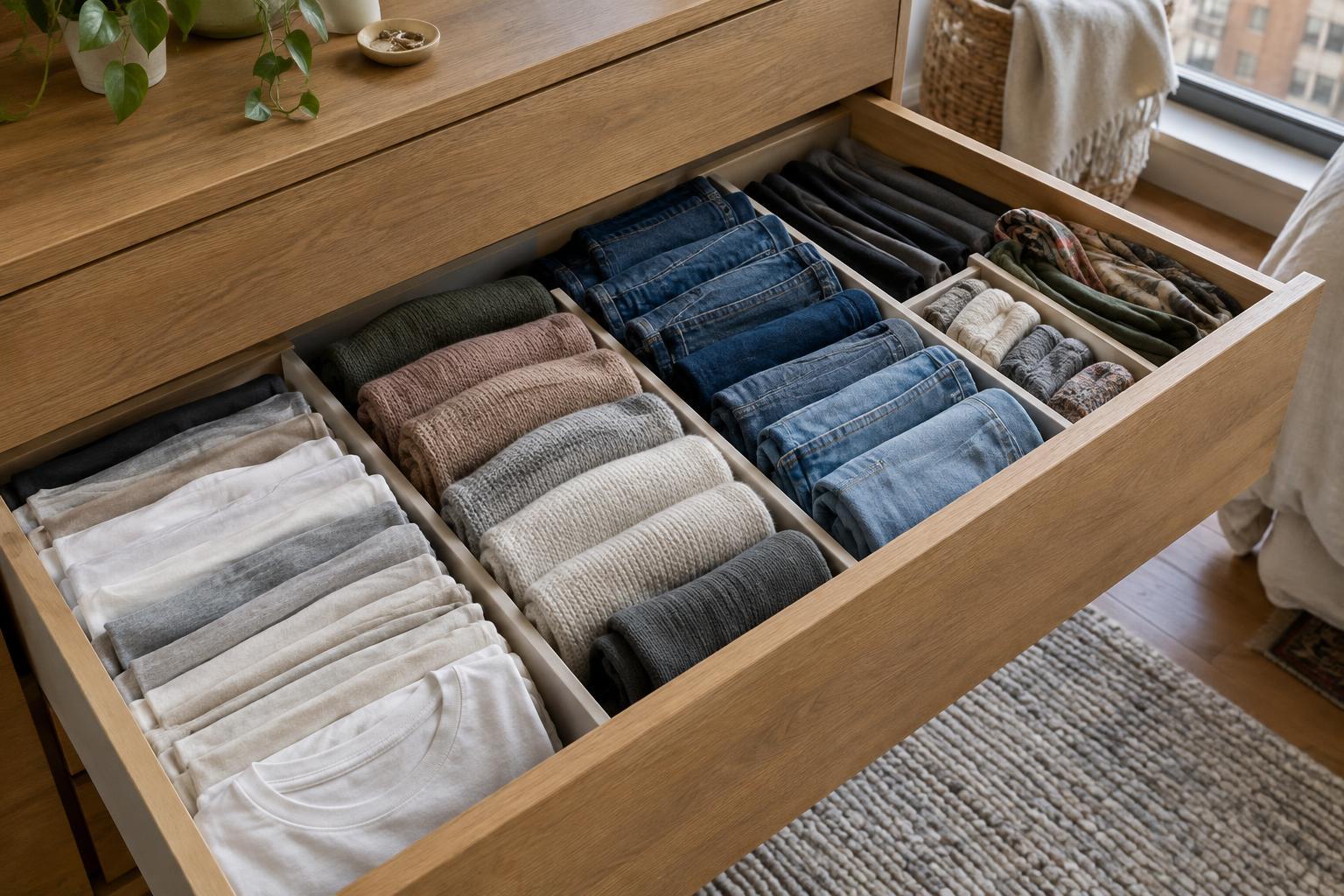
Within a drawer, divide broad categories into smaller groups only when it makes finding things easier. You might keep plain T-shirts apart from printed ones, or everyday socks apart from thicker pairs. Leave some breathing room between groups. A drawer packed so tightly that you must lift out a pile to reach one item will be difficult to maintain, however neatly it was arranged on the first day.
Fold clothes so the front row does not hide the back
Vertical folding can make soft items easier to see. Fold each T-shirt, pair of leggings or lightweight knit into a compact rectangle that can stand on its edge, then place the pieces in rows from front to back. Open the drawer and you can scan the row rather than searching through a stack. The fold does not need to be exact; it only needs to let the item fit comfortably and remain visible.
Not every garment suits an upright row. Bulky jumpers may take up too much room, while slippery fabrics may fall over. Try a short stack for those pieces, preferably with only a few items in it. Delicate garments may be better stored loosely or hung, depending on the fabric and available space. Let the clothing and the drawer depth determine the method instead of forcing one folding technique on everything.
Use boundaries without overcomplicating the drawer
Small items tend to spread into any empty corner. Drawer dividers, shallow boxes or containers you already own can give socks, tights and underwear a defined place. Measure the inside of the drawer before adding anything rigid, and check that the drawer still closes without catching on the contents. A few useful compartments are better than so many that putting laundry away becomes a puzzle.
Keep the boundaries flexible. A section labelled only by its contents may stop working when your routine changes or a season brings different clothes into rotation. If one group regularly overflows while another has spare room, adjust the space between them. The point is to make each item easy to find and return, not to preserve an arrangement that no longer fits.
Make the system easy to reset
An organised drawer stays useful when putting clothes away is almost as quick as dropping them into a pile. After laundry, return items to their usual rows or compartments, placing newly washed pieces where they are easy to reach. If a drawer starts to jam or a category spills into another, treat that as a sign to reassess its space rather than pressing everything down.
A brief check when you put laundry away is often enough: straighten a row, reunite stray items and move anything that belongs elsewhere. You can revisit the full layout when your clothing or daily routine changes. The best arrangement is not necessarily the most photogenic one; it is the one that lets you open a drawer, spot what you need and get on with your day.