Start with what you actually carry
A wallet should fit your routine, not the contents of a drawer. Before shopping, lay out the items you regularly take into the city: payment cards, ID, transit pass, keys you keep with your cards, receipts and any cash you use. Separate daily essentials from cards you reach for only occasionally. This gives you a more useful starting point than choosing a shape because it looks compact in a product photo.
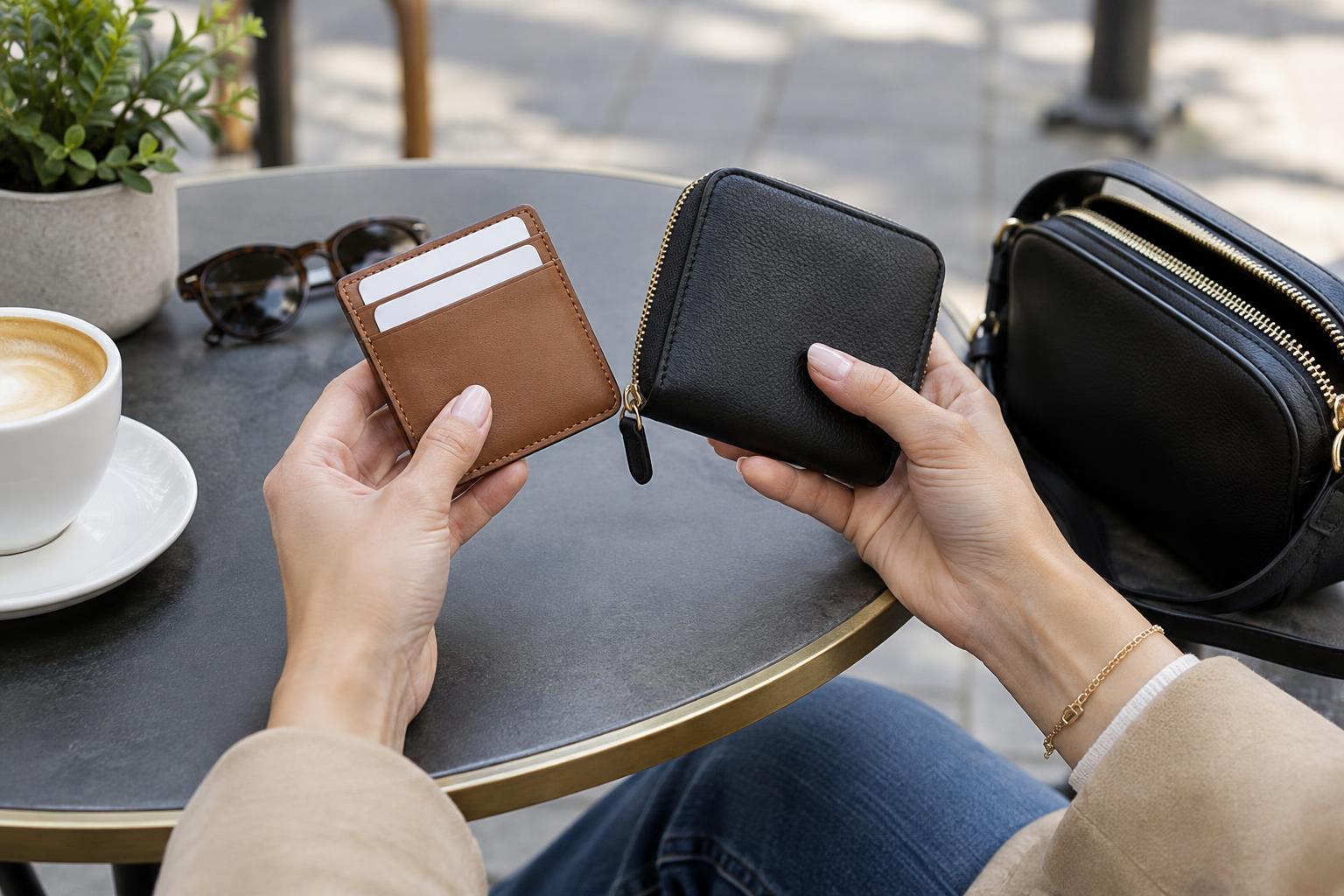
A slim cardholder suits a light load and can move easily between a work tote and a small weekend bag. A larger wallet makes more sense if you regularly carry cash, coins or several documents. There is no advantage to the smallest option if you have to force cards into tight slots or carry loose change elsewhere. Leave a little room for the occasional receipt, but avoid filling every compartment simply because it is there.
Make frequent items easy to reach
Think through a typical journey. You might need a transit pass at a station, a payment card at a café and ID at another point in the day. Place the item you use most in a slot you can identify by touch, while keeping less-used cards farther inside. Distinct slot positions can be easier to manage than a stack of nearly identical cards. If you switch bags often, a consistent layout also makes it easier to notice when something is missing.
Test access with one hand if possible, especially if the other is usually holding a bag or a coat. Cards should slide out without a struggle but should not fall free when you turn the holder over. A clear window may be convenient for an ID you need to show, though it is less appealing if it displays personal details whenever you open your wallet. Quick access is useful; having everything visible at once is not necessary.
Choose security features that fit your habits
A secure wallet starts with dependable construction. Check that stitching is even, edges feel sturdy and any zip, snap or magnetic closure stays shut when the wallet is full. Open-top cardholders can be convenient, but the cards should fit firmly in their slots. If you carry coins, a closed pocket helps prevent them from collecting at the bottom of your bag. A chain or wrist strap may be useful in some situations, provided it does not make the wallet awkward to use.
Where you carry it matters as much as its closure. An inner bag pocket is generally less exposed than an open outer pocket, and a wallet is easier to keep track of when it has a regular place. RFID-blocking materials are available if that feature matters to you, but they are not a substitute for watching your belongings and checking your accounts through your usual channels. Choose a design you can use calmly rather than one that makes every payment a complicated process.
Match the size to your bags and clothes
A wallet that works beautifully in a tote may feel bulky in a crossbody bag or jacket pocket. Check its dimensions against the smallest bag you use regularly, allowing space to take it out without emptying the bag. Depth matters too: a stuffed wallet can distort a compact bag even when its length and width technically fit. If you alternate between large and small bags, a cardholder for daily essentials and a separate pouch for occasional extras may be simpler than moving everything each time.
Materials affect how a wallet feels and wears. Smooth surfaces are easy to slip into a pocket, while textured ones may be easier to grip. Light colours can help you spot a wallet inside a dark bag, though they may show marks more readily. A bright lining offers visibility without committing to a colourful exterior. Consider how the finish looks with your work bag and weekend accessories, but put comfortable handling ahead of a perfect match.
Do a short everyday-use check
Before deciding, fill the wallet with the number of cards and other items you expect to carry. Close it, turn it over and try retrieving your most-used card several times. Notice whether the closure strains, the corners catch on your bag lining or the slots make you expose every card to find one. If you are buying online, compare the listed dimensions with a wallet you already own and check whether the compartments suit your actual contents.
Once you have chosen one, a small routine helps it stay useful. Return cards to the same slots, clear out receipts periodically and check that the closure still works well as the material softens. The best choice is not necessarily the most minimal or the most feature-packed. It is the one that lets you find what you need promptly, put it away securely and carry on with your day.