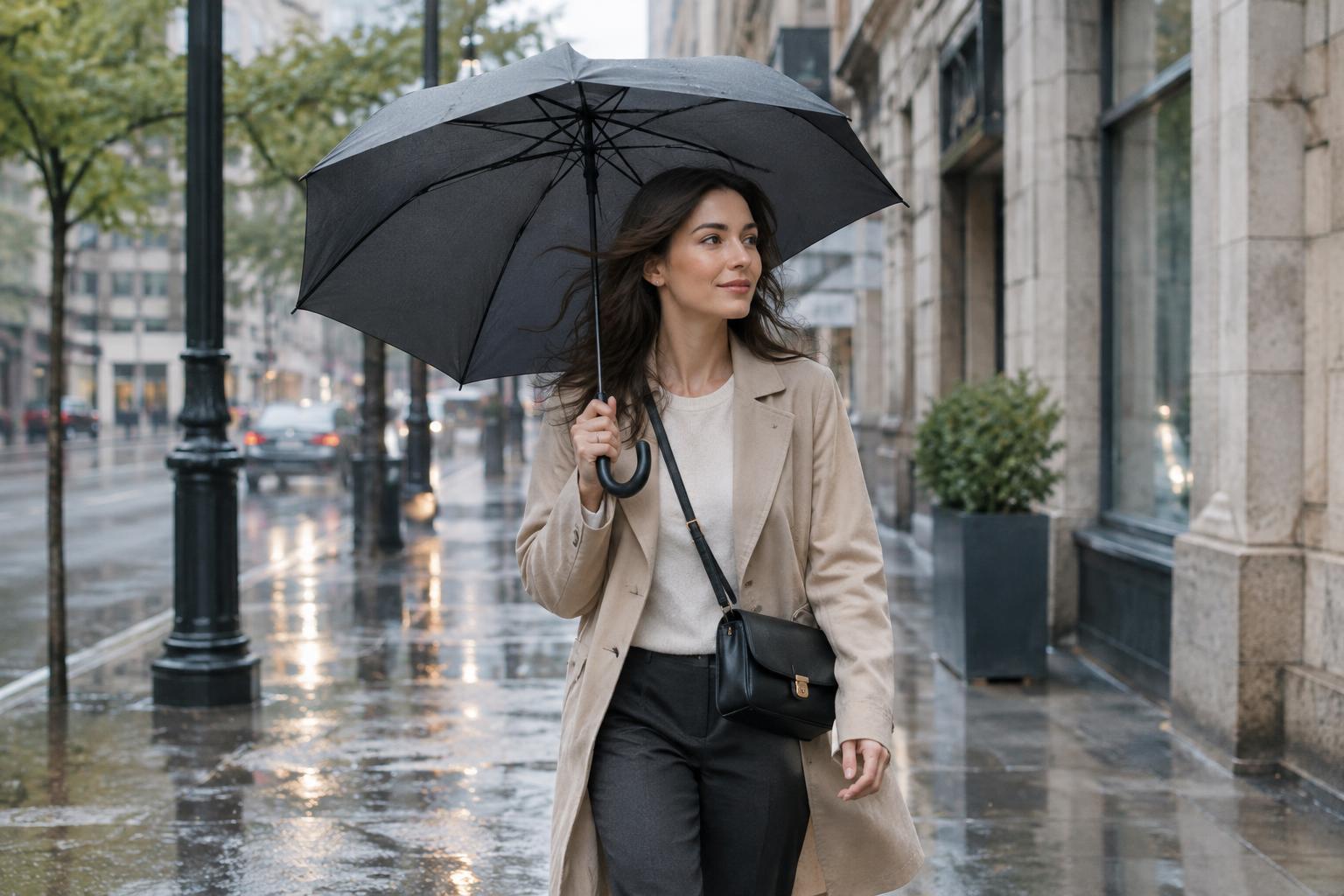
Start with the walk you actually make
The best compact umbrella is not necessarily the smallest one on the shelf. Think about where you will carry it and what it needs to cover. An umbrella that lives in a small handbag may need a short folded length, while one kept in a work tote can be slightly larger. If you regularly walk with a laptop bag or wear a structured coat, a wider canopy may be worth the extra space.
Check both folded length and open canopy width when comparing options. A tiny umbrella can be convenient on a dry morning but frustrating when rain reaches your shoulders or bag. Weight matters too, especially if you carry it every day rather than only when rain is forecast. The useful compromise is an umbrella you will bring along that still gives you enough coverage for your usual journey.
Look for a frame that can flex
City wind can change direction around buildings, and a compact umbrella may turn inside out in a strong gust. No small umbrella is windproof, but a frame that flexes without easily bending out of shape is more useful than one that feels rigid and fragile. Look for neatly joined ribs and stretchers, and check that the canopy opens evenly without loose or twisted sections. Flexible materials, including fiberglass in some designs, can help a frame recover from movement, though construction quality matters as much as the material named on a label.
More ribs do not automatically mean better wind performance; they can also add weight. A vented canopy may let some air pass through and reduce pressure in a gust, but its overlapping layers need to sit properly to keep rain out. If you can handle the umbrella before buying, open and close it a few times. The mechanism should move smoothly, and the open frame should feel steady rather than wobbly.
Balance rain coverage with crowded spaces
A generous canopy helps keep your sleeves and bag drier, but width has a practical limit on narrow pavements and busy entrances. Consider your height, the bag you carry and whether you often walk alongside someone. A slightly larger compact umbrella may suit a longer walk to work; a narrower one may be easier to navigate through crowds. Curved canopy edges can offer a little more shelter at the sides, but shape is no substitute for enough overall coverage.
Pay attention to the fabric and its seams. The canopy should feel securely attached to the frame, with stitching that looks even and no visible gaps around the top. A water-repellent finish helps rain roll off rather than cling to the fabric, but finishes can lose effectiveness with use. Dark colours may hide marks from daily travel, while a brighter colour can make an umbrella easier to spot among similar ones.
Make opening, closing and gripping easy
An umbrella is most useful when you can manage it outside a station, shop or office without a struggle. Automatic opening is convenient when one hand is occupied, but test the button placement and be aware that some automatic models need extra force to reset after closing. A manual mechanism may be simpler and lighter. Whichever you prefer, the sliding parts should not catch your fingers, and the canopy should close neatly enough to secure its strap.
The handle deserves a close look. It should sit comfortably in your hand, even when wet, without making you grip too tightly. A wrist loop can help when you need to free a hand briefly, but it is not a substitute for a secure hold in wind. Also check the sleeve: a roomy one makes a damp umbrella easier to put away temporarily, though it should not become its long-term storage place.
Know when to put it away and how to keep it ready
Even a well-made compact umbrella has limits. If gusts make it hard to control, closing it may be safer than fighting the wind, particularly near traffic or other pedestrians. Hold it low enough to protect yourself without blocking your view, and take care with the rib tips in a crowd. For exposed routes where strong wind is common, a hooded raincoat can be a useful backup.
After a rainy trip, shake off excess water where it will not splash others and let the umbrella dry fully before returning it to its sleeve or bag. Close it gently rather than twisting the ribs into place. Occasionally check for loose stitching, bent parts and a closure strap that still holds. An umbrella that is easy to dry, repack and carry is more likely to be ready the next time the weather changes.


