Start with what the belt needs to do
A belt can hold up trousers, add a finishing detail to jeans or change the shape of a dress. Those jobs call for slightly different features, so begin with the clothes you actually wear. If your trousers fit well without a belt, you may want one mainly for its appearance. If your jeans need support through a day of walking and sitting, comfort and a secure fastening matter more.
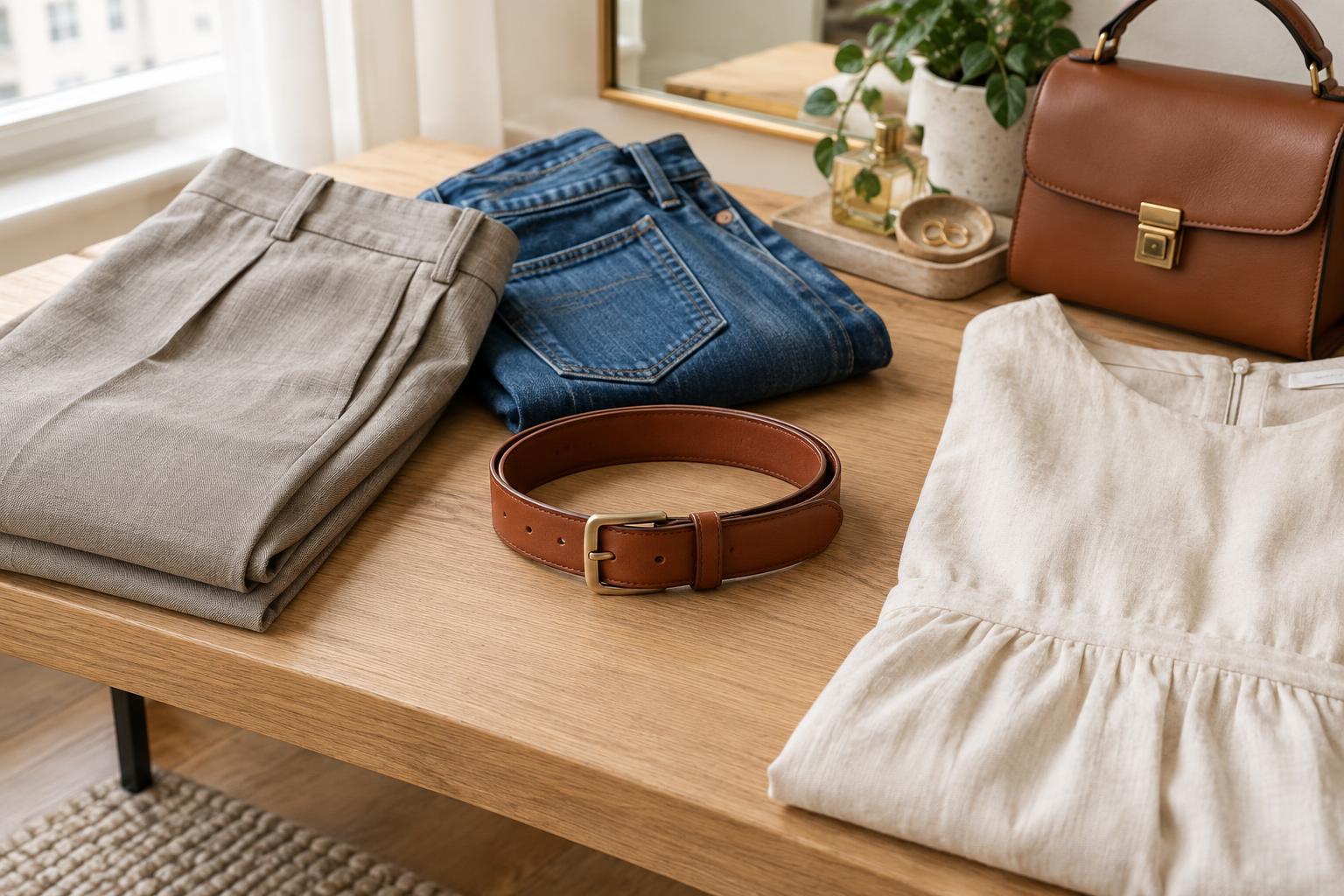
Lay out a pair of workday trousers, your most-worn jeans and a dress you might belt. Check where the belt would sit on each garment: at the hips, at the waist or over a layer of fabric. One belt may work in all three places, but a belt that fits your jeans at the hips may be too long to wear at the waist over a dress. Deciding which outfits matter most will make the choice easier.
Choose a width that suits your clothes
Width is the first practical constraint. A belt must pass comfortably through the loops on your trousers and jeans without folding or forcing the fabric. Measure the narrowest set of loops you plan to use, then look for a belt slightly narrower. A medium-width belt is often a useful starting point because it can look substantial with denim without overwhelming tailored trousers. The right width still depends on your particular clothes and the look you prefer.
Dresses offer more freedom because they often have no loops. A narrow belt can define the waist without changing the dress’s overall line very much, while a wider one makes the waist more noticeable. Try either with the dress’s fabric in mind: a structured cotton dress may hold a firm belt neatly, whereas a soft, flowing dress may gather more comfortably under a flexible one. Check the result from the side as well as the front, especially if the dress has pockets or a seam near the waist.
Check the fit in more than one position
Belt sizes and hole spacing vary, so trying a belt on is more reliable than choosing by its label alone. Fasten it with the trousers or jeans you intend to wear, then sit, stand and walk a few steps. It should feel secure without digging in, and the loose end should reach a keeper loop or lie neatly against the belt. If you have to use the last hole for every outfit, you have little room to adjust for different fabrics or waist positions.
For a dress, place the belt where it feels natural rather than automatically choosing the narrowest point of your waist. A belt worn over a cardigan or shirt dress needs room for that extra fabric. If you want to switch between hip-level jeans and waist-level dresses, consider a design with enough adjustment for both, such as closely spaced holes or a sliding buckle. Otherwise, two belts in different lengths may be more useful than one that fits neither outfit well.
Keep the material and buckle easy to wear
The best material is one that suits your routine. A firm leather belt can give jeans and tailored trousers a crisp finish, while a softer leather or woven belt may move more comfortably over a dress. If you prefer a non-leather option, check how the surface and edges feel when the belt bends; stiffness and rough edges can be noticeable during a long day. Whatever the material, look for tidy stitching or securely finished edges and a fastening that you can use easily.
Buckles also affect versatility. A simple, moderate-sized buckle is usually easier to pair with both workday clothes and relaxed outfits than a large decorative one. Think about how it sits when you are seated, particularly if you commute or spend time at a desk. Metal colour can echo jewellery or bag hardware, but it does not need to match everything. A belt that feels comfortable and looks intentional with your most-worn outfits will be more useful than one chosen to follow a strict matching rule.
Build outfits before you buy
Test a prospective belt against three specific outfits: trousers and a tucked-in top, jeans and a casual layer, and a dress worn on its own or with a cardigan. With trousers, notice whether the buckle sits smoothly beneath a jacket. With jeans, check that the belt fills the loops without drawing attention away from the rest of the outfit. With a dress, try fastening it loosely first, then adjust until the fabric falls comfortably rather than bunching above and below it.
If you are choosing one everyday belt, a restrained colour that works with several pairs of shoes or bags can make styling simpler. It need not be an exact match. Before buying, ask whether the belt fits your real outfits, stays comfortable as you move and can be fastened neatly in every position you plan to wear it. Those checks are more useful than trying to find a belt that promises to work with everything.