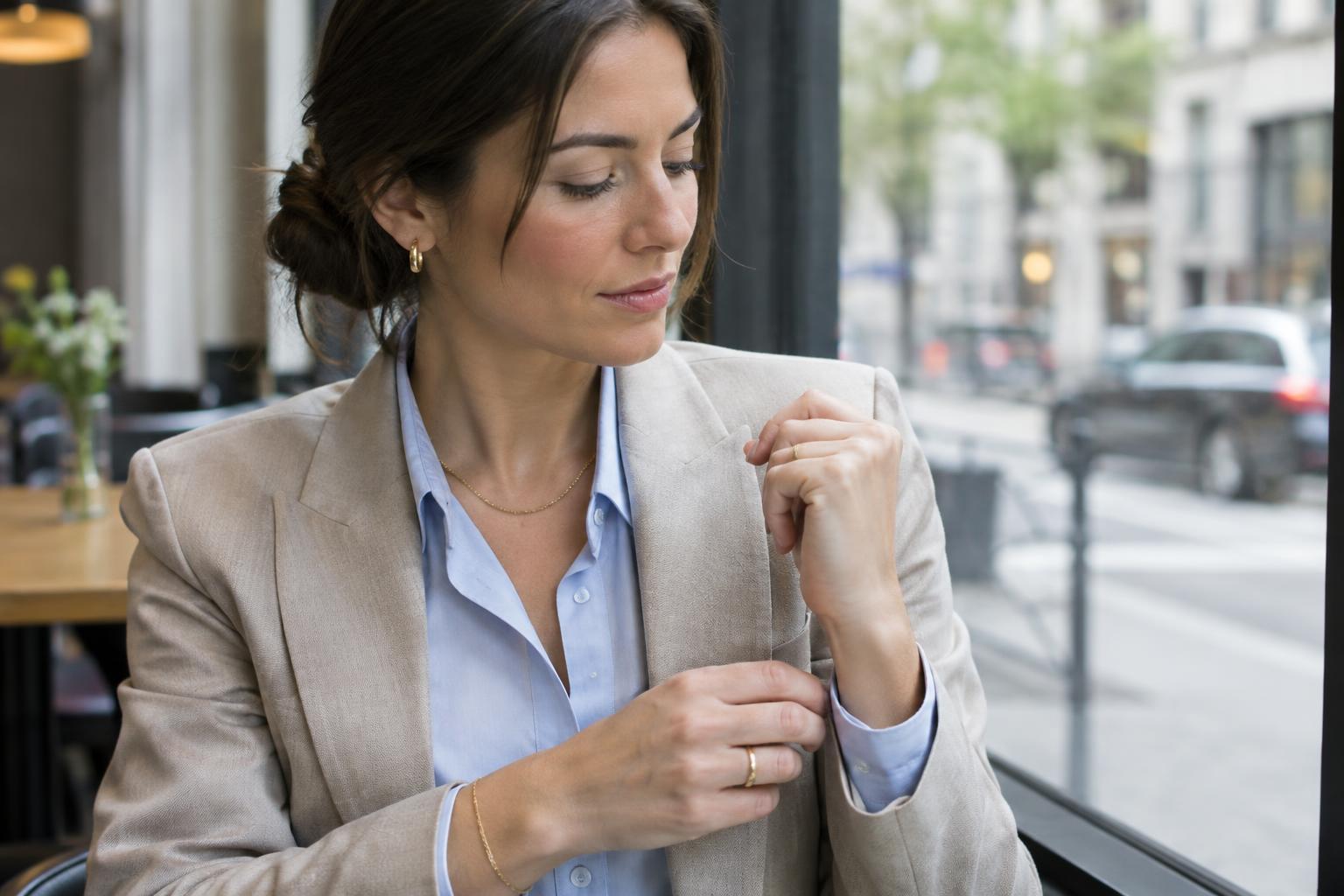
Start with the shape of your day
The most useful everyday jewelry is easy to forget you are wearing. Think through the movements that fill a typical day: putting on a coat, carrying a bag, using headphones, working at a keyboard and washing your hands. A piece that looks effortless in the mirror may be less appealing if it catches on a scarf or needs straightening after every commute.
Before choosing a piece, try it with the clothes and accessories you actually use. Turn your head, reach for your bag and pull on your outer layer. Notice whether an earring presses against headphones, a necklace slips under a collar or a bracelet lands beneath your wrist while you type. These small checks are more useful than deciding by appearance alone.
Choose earrings that suit movement
Small studs, close-fitting hoops and short drops can all work for a busy day. The right choice depends on how they feel alongside your hair, glasses, headphones and clothing. Smooth edges are less likely to catch on knits than sharp details or exposed hooks. Check that both earrings feel balanced; even a small pair can become distracting if one pulls noticeably more than the other.
Closures deserve as much attention as the visible design. An earring back should sit securely without pinching, and a hoop clasp should close cleanly rather than spring open with a light touch. Give each fastening a gentle check before leaving home, especially after changing earrings in a hurry. If your ears are sensitive to certain materials, pay attention to the components that touch your skin rather than relying on a broad label such as “hypoallergenic.”
Keep necklaces and bracelets out of the way
For a necklace you can wear through several parts of the day, consider where it falls against your usual necklines. A shorter chain may stay visible above a crew neck, while a slightly longer one can sit neatly over a simple top. Neither is automatically better: the goal is to avoid a length that repeatedly catches on a collar or disappears into your clothing. A clasp that you can operate comfortably also makes the piece easier to reach for each morning.
Layering looks relaxed when the chains have room to sit separately. If yours tangle easily, try wearing one necklace at a time or choosing pieces with noticeably different lengths. For bracelets, test comfort at a desk as well as while walking. A slim chain or smooth cuff may feel less intrusive than a stack that slides over your hand or knocks against a keyboard. Check that a cuff stays in place without squeezing and that a chain bracelet cannot slip off when you remove a coat.
Make rings practical for hands-on tasks
Rings are especially noticeable when you carry shopping, grip a handrail or work with your hands. Smooth, lower-profile designs are often easier to wear under gloves and less likely to snag pockets than raised settings. Try bending your fingers and holding your usual bag before committing to a ring as an everyday piece. If it spins, digs in or makes routine tasks awkward, its appearance may not make up for the distraction.
A comfortable fit can change with temperature or activity, so avoid judging a ring by a single moment. It should feel secure without being difficult to remove under ordinary conditions. If you regularly take rings off to wash dishes, exercise or do messy work, decide where you will put them before you remove them. A small pouch in your bag is easier to keep track of than a loose ring on a café table.
Build a small, reliable rotation
An everyday collection does not need many pieces. A dependable pair of earrings, one necklace that works with several necklines and an optional ring or bracelet can cover a range of workday and weekend outfits. Keeping the most-used pieces together helps you see what is ready to wear and spot a loose clasp before it becomes a problem.
At the end of the day, take a moment to put each piece back in its place rather than dropping everything into one compartment. Separate chains so they do not knot, and check fastenings when you notice a change in how they feel. Jewelry that stays put is partly a matter of choosing the right design and partly a matter of noticing what works with your own routine. Keep the pieces that make getting dressed easier, and let the fussy ones wait for a less demanding occasion.


