Start with what you actually wear
Before buying an organiser, bring your belts, scarves and jewellery together in one place. Check coat pockets, handbags and the spot where you usually take things off. Group similar items and look for duplicates, damaged pieces and anything you no longer enjoy wearing. You do not need to make every decision at once: set uncertain items aside and revisit them after you have organised the pieces you use.
Next, separate frequent favourites from occasional accessories. A belt you wear to work each week needs a more convenient home than one reserved for a particular outfit. The same goes for an everyday necklace versus jewellery worn only for an evening out. This distinction helps you choose storage based on how you get dressed, rather than trying to fit everything into one attractive but awkward display.
Give each category its own kind of space
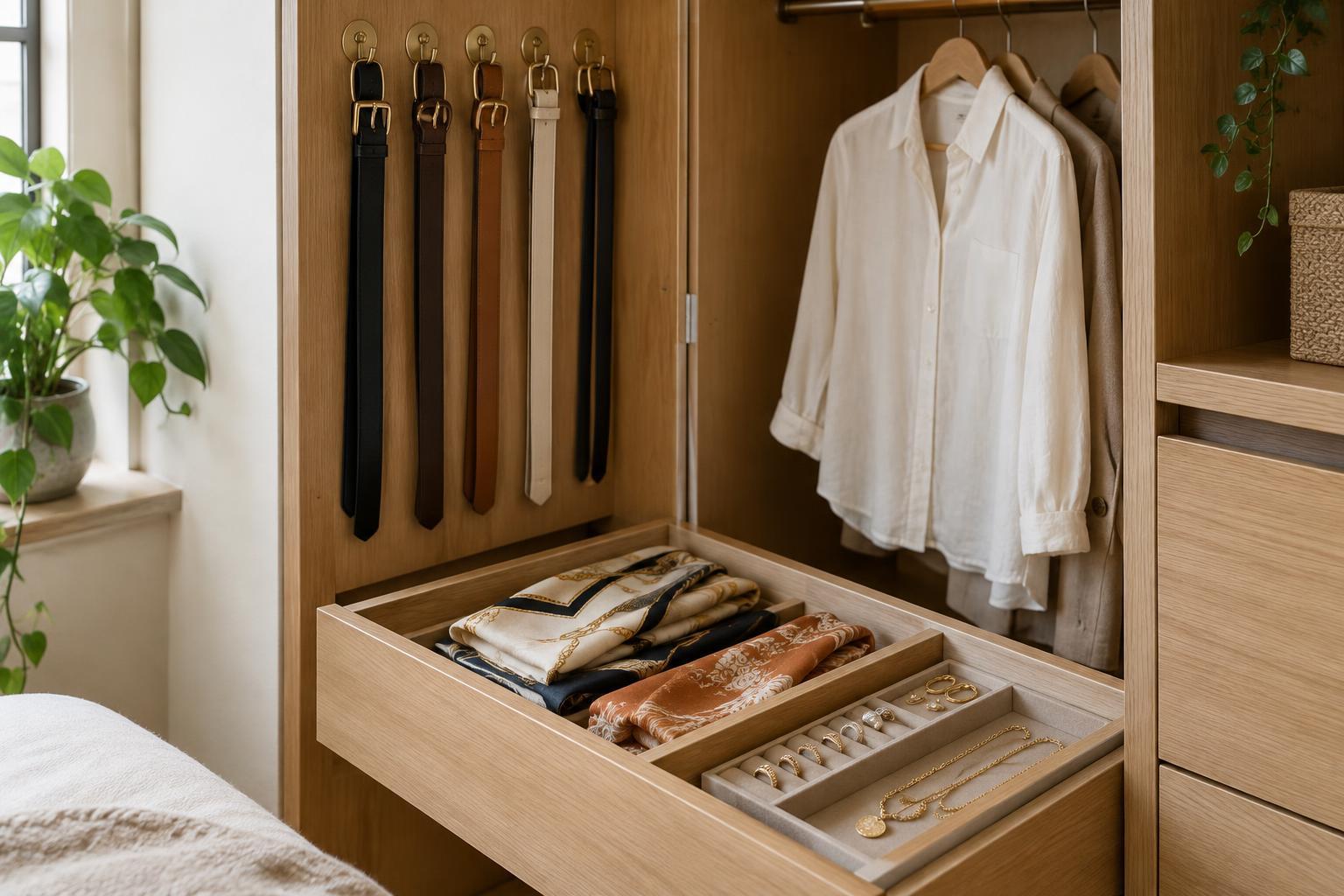
Belts are easiest to find when you can see their buckles or colours. If you have hanging space, use sturdy hooks or a belt hanger that leaves enough room to remove one without dislodging the others. In a drawer, loosely coil each belt and place it in a separate compartment or shallow box. Avoid forcing stiff belts into tight coils; a fold or a hanging position may suit them better.
Scarves need a little more flexibility. Fold delicate or bulky scarves on a shelf or in a drawer, with the ones you reach for most near the front. A few everyday scarves can hang on hooks if they will not snag or stretch there. Resist stacking a tall pile that has to be rebuilt every time you choose the scarf at the bottom. A low row of folded scarves is usually simpler to maintain.
Keep jewellery visible without letting it tangle
Jewellery benefits from smaller, defined spaces. A divided tray, a set of small dishes or boxes you already own can separate rings, earrings and bracelets. Give pairs of earrings a shared compartment and leave enough room to pick them up easily. Necklaces can hang individually on hooks or lie separately in a divided tray, depending on the space available and how delicate they are.
Think about the environment as well as the layout. Keep jewellery away from damp spots and places where it is likely to be knocked over. If pieces are easily scratched or tangled, store them apart rather than dropping them into a single dish. A small tray near your getting-ready area can hold the items you wear regularly, while less-used pieces stay in a drawer or box.
Make the system fit your daily route
The best storage spot is not necessarily where you have the most empty space. It is where you naturally reach for an accessory and where you can put it back without effort. If you choose jewellery in front of a mirror, keep your everyday pieces nearby. If you pick a scarf just before leaving, a hook near your outerwear may be more useful than a box deep in the wardrobe.
For a compact wardrobe, use a few clearly defined zones rather than spreading accessories across every available surface. One drawer section might hold jewellery, a narrow shelf might hold folded scarves, and a hook might hold your most-used belts. Leave a little room in each zone. When storage is packed tightly, even a sensible arrangement becomes difficult to use.
Keep it working with a quick reset
Once everything has a home, pay attention to where items still collect. A scarf left over a chair or earrings left on a bedside table may signal that the assigned spot is inconvenient. Move the storage closer to where you remove those items, or add a small landing spot that you can empty regularly. Let your habits shape the system instead of treating every misplaced accessory as a failure.
Every so often, straighten the folded scarves, separate any tangled necklaces and check whether your most-used items are still the easiest to reach. When your outfits or routines change, swap occasional pieces into the back and bring current favourites forward. The goal is not a perfect display; it is a wardrobe where you can find the finishing touch and put it away again without a search.